THE PLACES ATLAS
Follow a ballad
to its landscape.
Select a numbered place or use the list. Markers are approximate, illustrative and not directions.
Nine places, nine threads
Choose a place to see its Robin Hood link.
Use official site information for access and opening times. A legend never gives permission to enter private land.
The atlas, in words, with sources
Nottingham · The sheriff’s town
Literature In the ballads Robin’s most frequent enemy is the Sheriff of Nottingham. Britannica (Scholars): Robin Hood ↗
Literature In the Gest, the proud Sheriff of Nottingham announces a match for all the best archers of the north. The prize is an arrow whose shaft is silver and whose head and feathers are red gold. Frank Sidgwick (ed.), Ballads of Robin Hood and other Outlaws (1912), Project Gutenberg ↗
Literature Robin and the potter swap clothes, and Robin goes to Nottingham to sell pots. He sells them far too cheaply: pots worth five pence for three. Frank Sidgwick (ed.), Ballads of Robin Hood and other Outlaws (1912), Project Gutenberg ↗
Read the linked notebook ↗Sherwood Forest · The royal forest and the Major Oak
History The name Sherwood was first recorded in 958, as Sciryuda, ‘the woodland belonging to the shire’. Nottinghamshire County Council: History of Sherwood Forest, Robin Hood and Major Oak ↗
History Sherwood became a royal hunting forest after the Norman invasion of 1066. Nottinghamshire County Council: History of Sherwood Forest, Robin Hood and Major Oak ↗
Tradition For centuries the Major Oak in Sherwood has been woven into the Robin Hood legend. RSPB: The Major Oak, a new chapter for a legend of Sherwood Forest (18 June 2026) ↗
History In June 2026 the RSPB reported that the Major Oak, ‘thought to be up to 1,200 years old’, failed to come into leaf that spring and is believed by experts to have died. RSPB: The Major Oak, a new chapter for a legend of Sherwood Forest (18 June 2026) ↗
Read the linked notebook ↗Barnsdale · The other forest
Literature The ballads generally link Robin with Barnsdale, in what is now South Yorkshire, though Robin Hood and the Monk sets its story in Sherwood Forest. Britannica (Scholars): Robin Hood ↗
History Sidgwick notes that in the early ballads Little John mentions Wentbridge, ‘which lies in the heart of Barnsdale’, yet knows every path in Sherwood. He thought there were once two groups of ballads, one set in Barnsdale and one in Sherwood. Frank Sidgwick (ed.), Ballads of Robin Hood and other Outlaws (1912), Project Gutenberg ↗
History Robin Hood’s Well, beside the Great North Road at Burghwallis in Barnsdale, is an ornamental well cover of about 1710 by Sir John Vanbrugh for the Earl of Carlisle. Historic England: Robin Hood’s Well, Burghwallis, list entry 1314882 ↗
Read the linked notebook ↗Kirklees · The priory and the grave
History Kirklees Priory, near Brighouse in West Yorkshire, was a small nunnery founded in the mid 1100s. It was surrendered to the Crown in 1539, when eight nuns lived there. Historic England: Kirklees Priory and Kirklees Park, list entry 1413828 ↗
Tradition Historic England records the tradition that Robin shot an arrow from his deathbed in the gatehouse of Kirklees Priory to choose where he would be buried. Historic England: Kirklees Priory and Kirklees Park, list entry 1413828 ↗
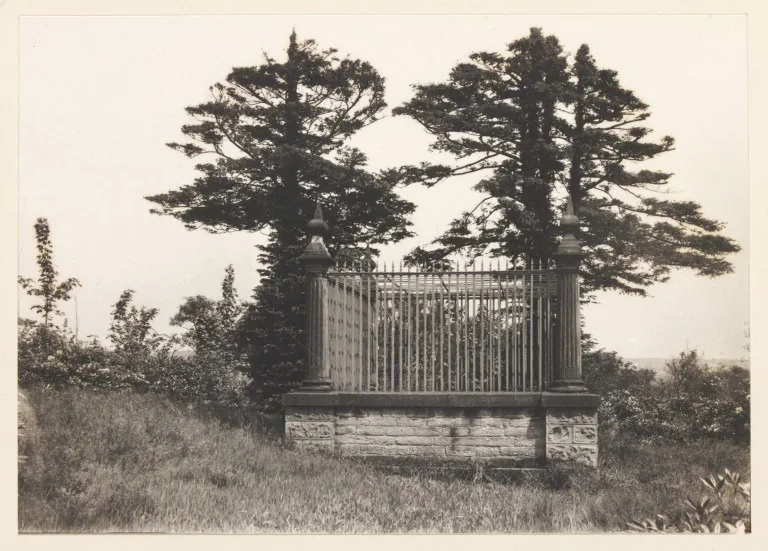
History Robin Hood’s Grave at Kirklees is a listed monument of the 1700s. Its inscription, in what Historic England calls ‘Chaucerian language’, ends ‘Obiit 24 Kal Dekembris 1247’. Historic England: Robin Hood’s Grave, Kirklees Park, list entry 1184066 ↗
Hathersage · Little John’s grave
Tradition Hathersage in Derbyshire has been the traditional birthplace of Little John for at least 250 years. The Derbyshire record itself calls him ‘mythological’. His so-called grave was already there in 1685. Derbyshire Historic Environment Record: Little John’s Grave, Hathersage (MDR4224) ↗
Tradition Church records show a bow, cap and horn hanging in Hathersage church in the 1400s. The grave has been cared for by the Ancient Order of Foresters since 1929. Derbyshire Historic Environment Record: Little John’s Grave, Hathersage (MDR4224) ↗
Read the linked notebook ↗York · St Mary’s Abbey and a court roll
History In the Gest, the knight’s lands are pledged to the abbot of ‘St. Mary Abbey’ in York. Frank Sidgwick (ed.), Ballads of Robin Hood and other Outlaws (1912), Project Gutenberg ↗
History The earliest record Ibeji points to: at a royal court held at York on 25 July 1225, the goods of ‘Robert Hod, fugitive’ were valued at 32 shillings and 6 pence. The next year’s account calls him ‘Hobbehod’ and shows he had been a tenant of the Archbishop of York. Dr Mike Ibeji, ‘Robin Hood and his Historical Context’ (2011, archived web article) ↗
Read the linked notebook ↗Fountains Abbey · The friar’s abbey
History Fountains Abbey, near Ripon in North Yorkshire, was a Cistercian monastery founded in the 1100s. Francis James Child (ed.), The English and Scottish Popular Ballads, vol. 3 (1888), Project Gutenberg ↗
Literature In the ballad of the Curtal Friar, Will Scadlock laughs that there is a friar at Fountains Abbey who could beat Little John and Robin too. Robin swears not to eat or drink until he has seen him. Francis James Child (ed.), The English and Scottish Popular Ballads, vol. 3 (1888), Project Gutenberg ↗
Read the linked notebook ↗Inglewood · A chronicler’s forest
History The Scottish chronicler Andrew of Wyntoun (about 1420) puts Robin Hood and Little John under the year 1283, in Inglewood and Barnsdale. Frank Sidgwick (ed.), Ballads of Robin Hood and other Outlaws (1912), Project Gutenberg ↗
Read the linked notebook ↗Sandleford · William Robehod
History A royal account roll of Easter 1262 records that the Prior of Sandleford, in Berkshire, was pardoned for seizing without warrant the goods of ‘William Robehod, fugitive’. Dr Mike Ibeji, ‘Robin Hood and his Historical Context’ (2011, archived web article) ↗
Read the linked notebook ↗