Retold in our own words from the Fifth Fytte of A Gest of Robyn Hode (Sidgwick’s 1912 edition) and Howard Pyle’s 1883 book · Published 30 October 2026
The match in the Gest
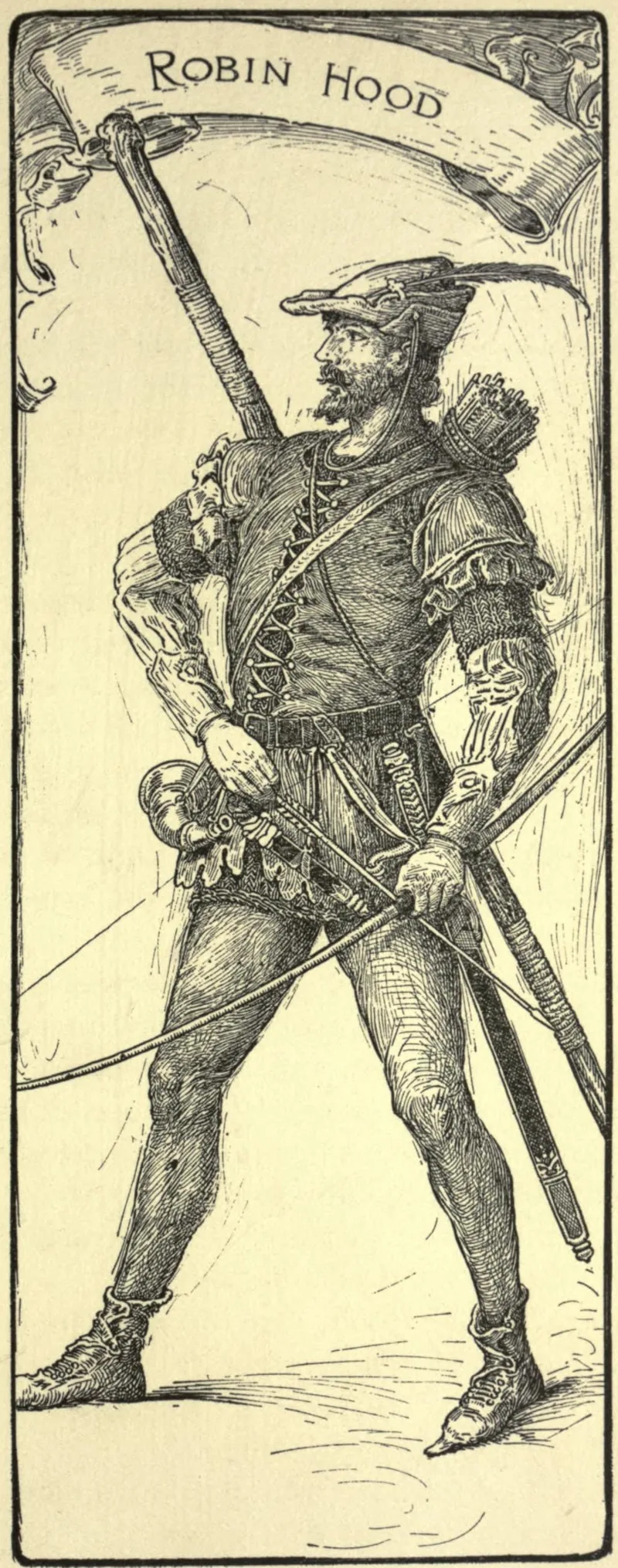
Literature In the Gest, the proud Sheriff of Nottingham announces a match for all the best archers of the north. The prize is an arrow whose shaft is silver and whose head and feathers are red gold. Frank Sidgwick (ed.), Ballads of Robin Hood and other Outlaws (1912), Project Gutenberg ↗
Literature Robin decides to go, partly to test whether the sheriff will keep the oath he swore in the greenwood. Frank Sidgwick (ed.), Ballads of Robin Hood and other Outlaws (1912), Project Gutenberg ↗
Literature Three times Robin shoots and splits the wand. He is the best of all, and the arrow is given to him. Frank Sidgwick (ed.), Ballads of Robin Hood and other Outlaws (1912), Project Gutenberg ↗
Treason at the butts
Literature Then the sheriff’s men blow their horns and attack. ‘Treason!’ cries Robin. The outlaws drive them back with their arrows and retreat towards the greenwood. Frank Sidgwick (ed.), Ballads of Robin Hood and other Outlaws (1912), Project Gutenberg ↗
Literature Little John is hit in the knee and cannot walk. He begs not to be left for the sheriff to find. Robin refuses to leave him, and Much carries him on his back for a mile. Frank Sidgwick (ed.), Ballads of Robin Hood and other Outlaws (1912), Project Gutenberg ↗
Literature They reach the castle of Sir Richard at the Lee, the knight Robin once helped. He shuts the gates against the sheriff and says Robin shall stay with him forty days. Frank Sidgwick (ed.), Ballads of Robin Hood and other Outlaws (1912), Project Gutenberg ↗
Pyle’s version
Literature Howard Pyle tells it differently. His prize is ‘an arrow of pure beaten gold’, and Robin comes in disguise as a ragged stranger in scarlet with a patch over one eye. Howard Pyle, The Merry Adventures of Robin Hood (1883), Project Gutenberg ↗
Literature Pyle’s Robin wins with a shot that knocks a grey goose feather off his rival’s arrow. Back in the forest he pulls off his disguise and jokes that the walnut stain will not wash so quickly out of his yellow hair. Howard Pyle, The Merry Adventures of Robin Hood (1883), Project Gutenberg ↗
Literature Howard Pyle’s Merry Adventures of Robin Hood (1883), which he also illustrated, stitched the old ballads together, ‘snipped and clipped and tied together again in a score of knots’, as his preface admits. Howard Pyle, The Merry Adventures of Robin Hood (1883), Project Gutenberg ↗
Where the Gest takes place
Literature The Gest is in eight ‘fyttes’ (parts). Sidgwick shows the first, second and fourth are set in Barnsdale, while the third, fifth and sixth, which deal with the Sheriff of Nottingham, centre mainly on Sherwood. Frank Sidgwick (ed.), Ballads of Robin Hood and other Outlaws (1912), Project Gutenberg ↗
Literature The name Sherwood never appears in the Gest itself. Frank Sidgwick (ed.), Ballads of Robin Hood and other Outlaws (1912), Project Gutenberg ↗
So the Gest’s sheriff is from Nottingham, yet the poem never says ‘Sherwood’. Keep an eye on which places each version actually names.
Follow the thread
Frank Sidgwick (ed.), Ballads of Robin Hood and other Outlaws (1912), Project Gutenberg ↗
Howard Pyle, The Merry Adventures of Robin Hood (1883), Project Gutenberg ↗
Retellings are in our own words. Every sentence above carries a label (History, Literature or Tradition) and a link to the source it was checked against. A ballad is not a historical record.
Source method & more reading ↗