Checked against Nottinghamshire County Council, the RSPB, Historic England, Britannica and Sidgwick’s edition · Published 30 October 2026
Two forests
Literature The ballads generally link Robin with Barnsdale, in what is now South Yorkshire, though Robin Hood and the Monk sets its story in Sherwood Forest. Britannica (Scholars): Robin Hood ↗
Literature Britannica notes that clues in the early ballads place the action chiefly in South Yorkshire, not Nottinghamshire. Britannica (Scholars): Robin Hood ↗
History Sidgwick notes that in the early ballads Little John mentions Wentbridge, ‘which lies in the heart of Barnsdale’, yet knows every path in Sherwood. He thought there were once two groups of ballads, one set in Barnsdale and one in Sherwood. Frank Sidgwick (ed.), Ballads of Robin Hood and other Outlaws (1912), Project Gutenberg ↗
Literature The Gest is in eight ‘fyttes’ (parts). Sidgwick shows the first, second and fourth are set in Barnsdale, while the third, fifth and sixth, which deal with the Sheriff of Nottingham, centre mainly on Sherwood. Frank Sidgwick (ed.), Ballads of Robin Hood and other Outlaws (1912), Project Gutenberg ↗
Literature The name Sherwood never appears in the Gest itself. Frank Sidgwick (ed.), Ballads of Robin Hood and other Outlaws (1912), Project Gutenberg ↗
Sherwood in the records
History The name Sherwood was first recorded in 958, as Sciryuda, ‘the woodland belonging to the shire’. Nottinghamshire County Council: History of Sherwood Forest, Robin Hood and Major Oak ↗
History Sherwood became a royal hunting forest after the Norman invasion of 1066. Nottinghamshire County Council: History of Sherwood Forest, Robin Hood and Major Oak ↗
History In the Middle Ages ‘forest’ was a legal term: land under special royal laws protecting timber and game, enforced by foresters, verderers and other royal officers. Nottinghamshire County Council: History of Sherwood Forest, Robin Hood and Major Oak ↗
History In the 1200s Sherwood covered about 100,000 acres, a fifth of Nottinghamshire, though it was never one unbroken mass of dense woodland: it mixed birch and oak with open sandy heath and rough grassland. Nottinghamshire County Council: History of Sherwood Forest, Robin Hood and Major Oak ↗
History In Victorian times Sherwood became a tourist attraction, helped by romantic novels such as Walter Scott’s Ivanhoe. Nottinghamshire County Council: History of Sherwood Forest, Robin Hood and Major Oak ↗
The Major Oak
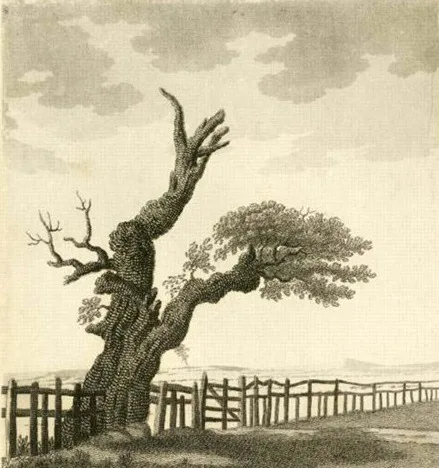
Tradition For centuries the Major Oak in Sherwood has been woven into the Robin Hood legend. RSPB: The Major Oak, a new chapter for a legend of Sherwood Forest (18 June 2026) ↗
History The Major Oak’s earliest recorded name was the Cockpen Tree, in the mid 1800s. In 1790 Major Hayman Rooke put it in his book on Sherwood’s ancient oaks, and the tree has been looked after continuously since 1908. Nottinghamshire County Council: History of Sherwood Forest, Robin Hood and Major Oak ↗
History Nottinghamshire County Council describes the oak as ‘at least 1000 years old’, with a trunk 10 metres round. Nottinghamshire County Council: History of Sherwood Forest, Robin Hood and Major Oak ↗
History In June 2026 the RSPB reported that the Major Oak, ‘thought to be up to 1,200 years old’, failed to come into leaf that spring and is believed by experts to have died. RSPB: The Major Oak, a new chapter for a legend of Sherwood Forest (18 June 2026) ↗
History The RSPB gives its trunk as around 11 metres round, with a 28-metre crown. It was voted Tree of the Year in 2014. RSPB: The Major Oak, a new chapter for a legend of Sherwood Forest (18 June 2026) ↗
The two sources disagree on the tree’s age (at least 1,000 years, or up to 1,200) and on its girth (10 metres, or about 11). Both are estimates, so we give both.
Barnsdale and the Great North Road
History Robin Hood’s Well, beside the Great North Road at Burghwallis in Barnsdale, is an ornamental well cover of about 1710 by Sir John Vanbrugh for the Earl of Carlisle. Historic England: Robin Hood’s Well, Burghwallis, list entry 1314882 ↗
History The Scottish chronicler Andrew of Wyntoun (about 1420) puts Robin Hood and Little John under the year 1283, in Inglewood and Barnsdale. Frank Sidgwick (ed.), Ballads of Robin Hood and other Outlaws (1912), Project Gutenberg ↗
A name that stuck
Tradition Robin’s name lives on in modern speech, for example in the phrase ‘Robin Hood tax’. Britannica (Scholars): Robin Hood ↗
Literature Alfred, Lord Tennyson wrote a Robin Hood play, The Foresters, in 1892. Britannica (Scholars): Robin Hood ↗
Follow the thread
Britannica (Scholars): Robin Hood ↗
Frank Sidgwick (ed.), Ballads of Robin Hood and other Outlaws (1912), Project Gutenberg ↗
Nottinghamshire County Council: History of Sherwood Forest, Robin Hood and Major Oak ↗
RSPB: The Major Oak, a new chapter for a legend of Sherwood Forest (18 June 2026) ↗
Historic England: Robin Hood’s Well, Burghwallis, list entry 1314882 ↗
Retellings are in our own words. Every sentence above carries a label (History, Literature or Tradition) and a link to the source it was checked against. A ballad is not a historical record.
Source method & more reading ↗