Retold in our own words from Child’s headnote to Robin Hood and Little John (Child 125) and Howard Pyle’s 1883 book · Published 30 October 2026
The story
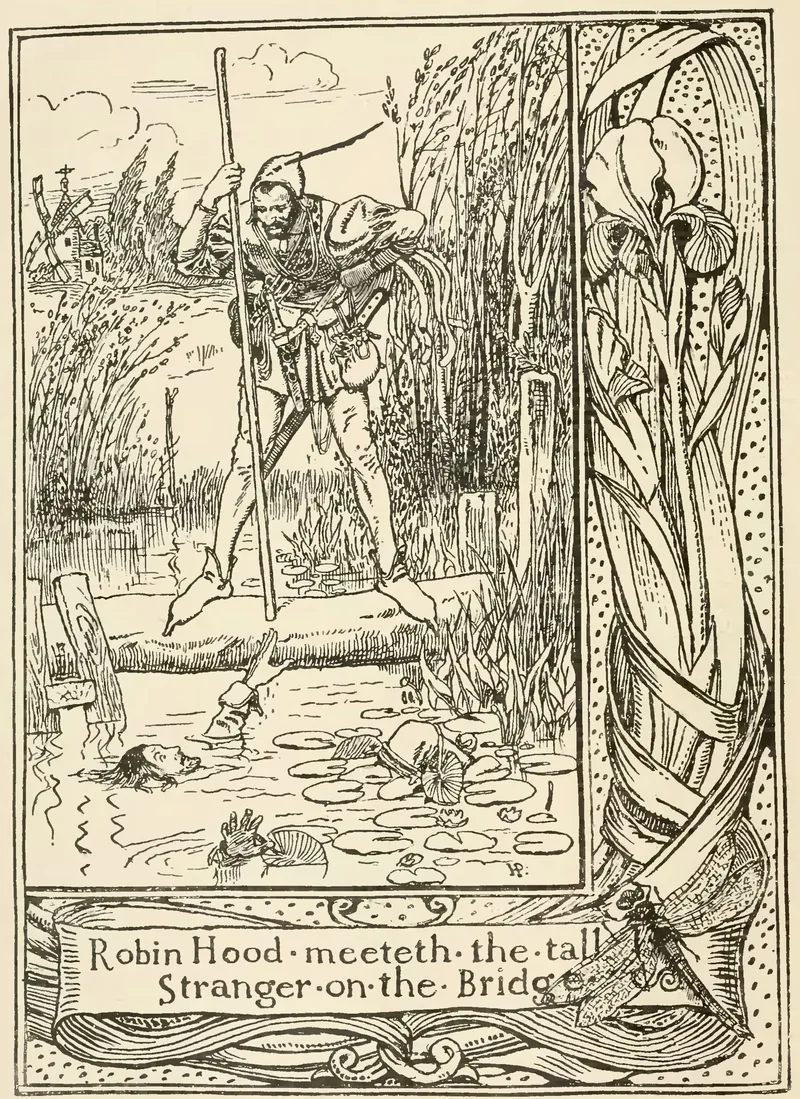
Literature In the ballad Robin Hood and Little John, Robin is only twenty but already leads a band of sixty-nine bowmen. One morning he goes into the forest alone, telling them to come if they hear his horn. Francis James Child (ed.), The English and Scottish Popular Ballads, vol. 3 (1888), Project Gutenberg ↗
Literature He meets a stranger on a long, narrow bridge, and neither will give way. Robin threatens him with an arrow, and is reminded that this is cowardly when the other man has only a staff. Francis James Child (ed.), The English and Scottish Popular Ballads, vol. 3 (1888), Project Gutenberg ↗
Literature So Robin lays down his bow and cuts himself an oak staff. They agree that whoever knocks the other into the water wins. Francis James Child (ed.), The English and Scottish Popular Ballads, vol. 3 (1888), Project Gutenberg ↗
Literature In Howard Pyle’s telling they fight on the bridge for a good hour, until the stranger tumbles Robin ‘heels over head into the water’. Robin climbs out laughing at himself. Howard Pyle, The Merry Adventures of Robin Hood (1883), Project Gutenberg ↗
Literature Robin blows his horn. His men rush up and want to give the stranger a ducking, but Robin stops them. Francis James Child (ed.), The English and Scottish Popular Ballads, vol. 3 (1888), Project Gutenberg ↗
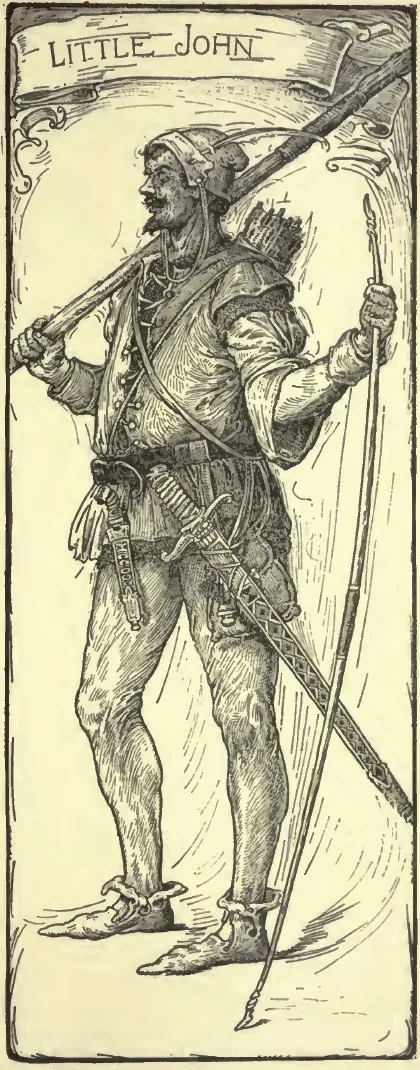
Literature The stranger joins the band. His name is John Little and he is seven foot tall, so Will Stutely says his name must be changed, and they rename him Little John. Francis James Child (ed.), The English and Scottish Popular Ballads, vol. 3 (1888), Project Gutenberg ↗
How old is this story?
Literature The story of Robin meeting Little John on the bridge is not medieval. Child found its oldest copy in A Collection of Old Ballads of 1723, written ‘in a rank seventeenth-century style’, and a list shows it was being sold by 1689. Francis James Child (ed.), The English and Scottish Popular Ballads, vol. 3 (1888), Project Gutenberg ↗
Literature In the 1880s the American scholar Francis James Child numbered the ballads. In his collection the Gest is No. 117, Guy of Gisborne 118, the Monk 119, Robin Hood’s Death 120, the Potter 121, the Curtal Friar 123 and Robin Hood and Little John 125. Francis James Child (ed.), The English and Scottish Popular Ballads, vol. 3 (1888), Project Gutenberg ↗
This is one of the best-known Robin Hood scenes, but it is not in any medieval manuscript. It is a 17th-century ballad that Howard Pyle later retold.
Little John in the oldest ballads
Literature The early ballads name only three companions who are always at Robin’s side: Little John; Much, the miller’s son; and Will Scarlet (also called Scathelock). Britannica (Scholars): Robin Hood ↗
Literature In the ballads Robin’s most frequent enemy is the Sheriff of Nottingham. Britannica (Scholars): Robin Hood ↗
Little John’s grave at Hathersage
Tradition Hathersage in Derbyshire has been the traditional birthplace of Little John for at least 250 years. The Derbyshire record itself calls him ‘mythological’. His so-called grave was already there in 1685. Derbyshire Historic Environment Record: Little John’s Grave, Hathersage (MDR4224) ↗
Tradition Church records show a bow, cap and horn hanging in Hathersage church in the 1400s. The grave has been cared for by the Ancient Order of Foresters since 1929. Derbyshire Historic Environment Record: Little John’s Grave, Hathersage (MDR4224) ↗
Follow the thread
Howard Pyle, The Merry Adventures of Robin Hood (1883), Project Gutenberg ↗
Britannica (Scholars): Robin Hood ↗
Derbyshire Historic Environment Record: Little John’s Grave, Hathersage (MDR4224) ↗
Retellings are in our own words. Every sentence above carries a label (History, Literature or Tradition) and a link to the source it was checked against. A ballad is not a historical record.
Source method & more reading ↗