Retold in our own words from Robin Hood and the Potter, as modernised in Sidgwick’s 1912 edition · Published 30 October 2026
The proud potter
Literature A proud potter drives his cart through the forest and has never paid ‘one penny of pavage’ (a road toll). Little John says he met him at Wentbridge and got three hard blows. Frank Sidgwick (ed.), Ballads of Robin Hood and other Outlaws (1912), Project Gutenberg ↗
Literature Little John bets Robin forty shillings that nobody can make the potter pay. Robin takes the bet. Frank Sidgwick (ed.), Ballads of Robin Hood and other Outlaws (1912), Project Gutenberg ↗
Literature The potter grabs a two-handed staff and knocks Robin’s shield out of his hand. Robin loses the bet, and pays up gladly. Frank Sidgwick (ed.), Ballads of Robin Hood and other Outlaws (1912), Project Gutenberg ↗
Pots for sale in Nottingham
Literature Robin and the potter swap clothes, and Robin goes to Nottingham to sell pots. He sells them far too cheaply: pots worth five pence for three. Frank Sidgwick (ed.), Ballads of Robin Hood and other Outlaws (1912), Project Gutenberg ↗
Literature He gives his last five pots to the sheriff’s wife, who invites him to dinner. At the archery butts afterwards, the ‘potter’ beats all the sheriff’s men and splits the target peg in three. Frank Sidgwick (ed.), Ballads of Robin Hood and other Outlaws (1912), Project Gutenberg ↗
Into the forest
Literature He offers to lead the sheriff to Robin Hood. In the forest he blows his horn, and the outlaws take the sheriff’s horse and goods. Frank Sidgwick (ed.), Ballads of Robin Hood and other Outlaws (1912), Project Gutenberg ↗
Literature The sheriff walks home. Robin sends his wife a white palfrey (a riding horse), and she laughs that he has now paid for all the pots. Frank Sidgwick (ed.), Ballads of Robin Hood and other Outlaws (1912), Project Gutenberg ↗
Literature Robin pays the real potter ten pounds for pots worth two nobles, and tells him he will always be welcome in the greenwood. Frank Sidgwick (ed.), Ballads of Robin Hood and other Outlaws (1912), Project Gutenberg ↗
The manuscript
Literature Robin Hood and the Potter survives in a manuscript of about 1500, also at Cambridge. Joseph Ritson first printed it in 1795. Frank Sidgwick (ed.), Ballads of Robin Hood and other Outlaws (1912), Project Gutenberg ↗
History Sidgwick notes that in the early ballads Little John mentions Wentbridge, ‘which lies in the heart of Barnsdale’, yet knows every path in Sherwood. He thought there were once two groups of ballads, one set in Barnsdale and one in Sherwood. Frank Sidgwick (ed.), Ballads of Robin Hood and other Outlaws (1912), Project Gutenberg ↗
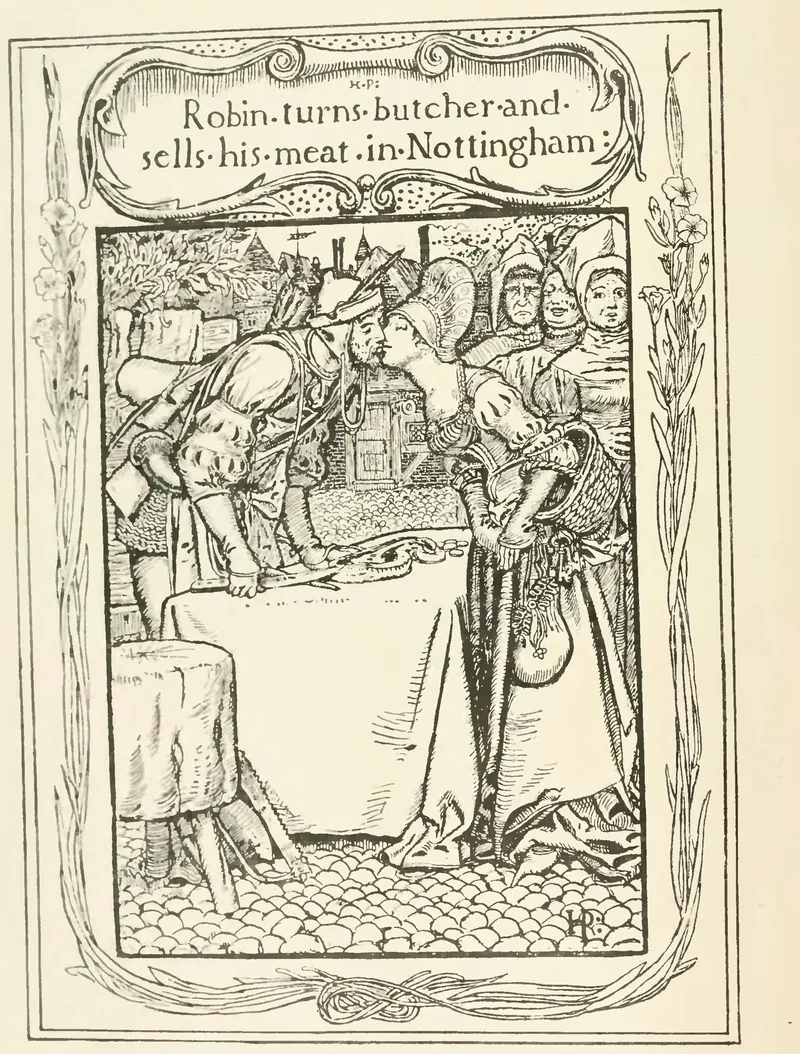
Howard Pyle’s 1883 book has a similar disguise story in which Robin sells meat in Nottingham as a butcher (pictured).
Follow the thread
Frank Sidgwick (ed.), Ballads of Robin Hood and other Outlaws (1912), Project Gutenberg ↗
Retellings are in our own words. Every sentence above carries a label (History, Literature or Tradition) and a link to the source it was checked against. A ballad is not a historical record.
Source method & more reading ↗