Retold in our own words from Britannica summaries of the later ballads; history of the idea from Sidgwick and Britannica · Published 30 October 2026
Not in the oldest ballads
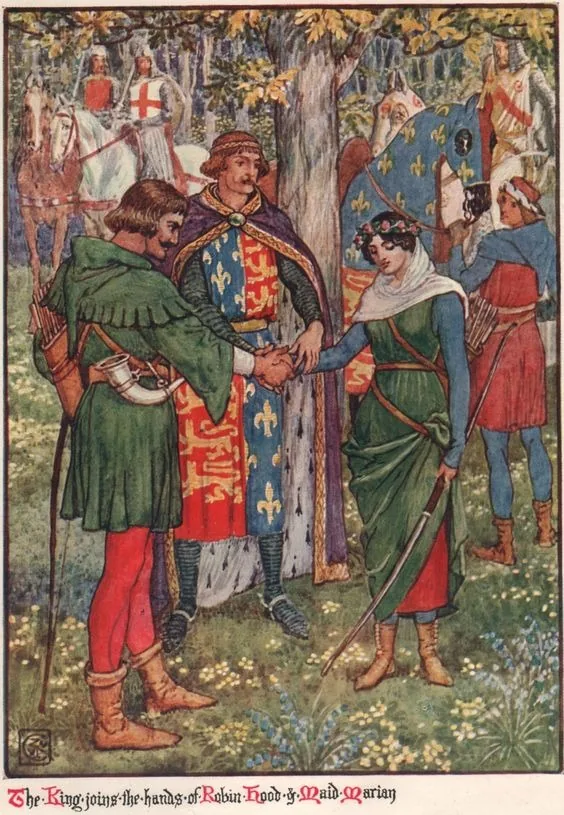
Literature Marian is not in the medieval ballads. Britannica says it was ‘postmedieval ballads’ that gave Robin a companion, Maid Marian. Britannica (Scholars): Robin Hood ↗
Literature Sidgwick points out there is no friar in Robin’s band in any of the older ballads, and no Maid Marian. Both appear in a play printed about 1560. Frank Sidgwick (ed.), Ballads of Robin Hood and other Outlaws (1912), Project Gutenberg ↗
A later ballad
Literature In one later ballad, when Robin is outlawed, Marian dresses as a page and goes looking for him in Sherwood. Britannica (Students): Robin Hood ↗
Literature Both are in disguise, and neither knows the other. They fight, until Robin, admiring her skill, invites her to join his band. Then she knows his voice. Britannica (Students): Robin Hood ↗
Where Marian came from
Literature Robin and Marian appear as a pair, separately from the outlaw, in John Gower’s poem Mirour de l’omme of the late 1370s. Britannica says this Robin and Marian only merged with the outlaw legend in the 1500s. Britannica (Scholars): Robin Hood ↗
Literature Sidgwick traces Marian to French May-time plays, in which ‘Robin and Marion’ were the names given to the king and queen of the festival. Frank Sidgwick (ed.), Ballads of Robin Hood and other Outlaws (1912), Project Gutenberg ↗
Tradition Between 1450 and 1500, Robin Hood became part of English May games, and parish records from all over England show the custom. Frank Sidgwick (ed.), Ballads of Robin Hood and other Outlaws (1912), Project Gutenberg ↗
Tradition In 1473 John Paston wrote that a servant he had kept to play ‘Saynt Jorge and Robyn Hod and the Shryff of Nottyngham’ had left him. Frank Sidgwick (ed.), Ballads of Robin Hood and other Outlaws (1912), Project Gutenberg ↗
Robin becomes an earl
Literature The idea that Robin was a fallen nobleman was added in the 1500s. Britannica (Scholars): Robin Hood ↗
History No claim that Robin was of noble birth has been found earlier than Grafton’s Chronicle of 1569. Frank Sidgwick (ed.), Ballads of Robin Hood and other Outlaws (1912), Project Gutenberg ↗
Literature In the plays about Robert, Earl of Huntingdon by Anthony Munday and Henry Chettle, first mentioned in 1598, the outlawed earl flees to Sherwood and calls Matilda, his companion, Maid Marian. Frank Sidgwick (ed.), Ballads of Robin Hood and other Outlaws (1912), Project Gutenberg ↗
History In 1746 the antiquary William Stukeley invented a noble family tree for ‘Robert Fitzooth, commonly called Robin Hood, pretended Earl of Huntingdon’. Frank Sidgwick (ed.), Ballads of Robin Hood and other Outlaws (1912), Project Gutenberg ↗
History Britannica says the popular idea that Robin lived in the time of Richard I comes from that made-up pedigree. Britannica (Scholars): Robin Hood ↗
Follow the thread
Britannica (Scholars): Robin Hood ↗
Frank Sidgwick (ed.), Ballads of Robin Hood and other Outlaws (1912), Project Gutenberg ↗
Britannica (Students): Robin Hood ↗
Retellings are in our own words. Every sentence above carries a label (History, Literature or Tradition) and a link to the source it was checked against. A ballad is not a historical record.
Source method & more reading ↗